 05 59 93 10 52
 Write to us


Wooden or Metal Hammock Stand: Which One to Choose ?
Should you choose a wooden or metal hammock stand? Wood appeals with its warm and natural aesthetic, while metal is reassuring due to its simplicity, mobility, and ease of maintenance. But in reality, the right choice mainly depends on your usage... and on a criterion that is often underestimated: the height of the stand.
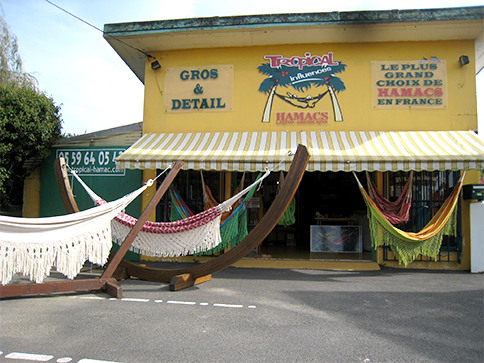
Since 1988, Tropical Hamac has been advising and assisting its customers in choosing hammock and stand sets. We were even among the first in the Landes region to manufacture our own wooden hammock stands. This comprehensive guide compares the advantages and disadvantages of wooden and metal stands to help you make the right choice for the long term.
The best hammock stand is not necessarily the one made of wood or metal, but the one whose geometry truly suits the hammock.
Our observation after more than 30 years of experience
After decades of advice, customer feedback, and practical trials, we still observe the same thing:
- The majority of errors come from a support that is too low ;
- Many of the stands sold on the market are poorly suited for true hammocks without bars ;
- Customers rarely regret a well-chosen wooden or metal stand, but often regret a poorly sized stand.
Conclusion: the material matters, but the design of the support remains essential.
Table of Contents
- Quick answer: wood or metal ?
- Pre-purchase checklist
- Criterion No. 1: the height of the support
- Wooden Hammock Stand: Advantages and Disadvantages
- Metal Hammock Stand: Advantages and Disadvantages
- Complete comparison wood vs metal
- Which support should you choose according to your use ?
- Real case: the most common mistake
- Common mistakes to avoid
- Maintenance: wood vs metal
- Our expert recommendation
- FAQ
- Our recommended supports
- In summary
Quick answer: wood or metal ?
Choose a wooden hammock stand if you are looking for an aesthetic, natural, durable, and warm look, with a beautiful integration into a garden, on a terrace, or near a pool. Choose a metal hammock stand if you prioritize mobility, easy disassembly, practicality, and generally easier maintenance in the short term. In all cases, first check the hanging height.. This is the number one criterion for comfort, especially with a hammock without bars.
The best hammock stand is not a matter of wood or metal, but of proportions.
Still unsure? Here's the easiest choice.
- You want a beautiful garden or a beautiful terrace: choose wood instead.
- You want something practical, portable, or detachable: opt for metal instead.
- You mainly want comfort: first of all, check the height suitable for the hammock. Choose a tall and long stand to enjoy a large, wide hammock.
Pre-purchase checklist: avoid 90% of mistakes
Even before choosing between wood and metal, note these 6 points:
- type of hammock: with bars or without bars ;
- hook-to-hook length ;
- actual length of the hammock ;
- Attachment height, a key criterion for comfort ;
- intended use: fixed or mobile ;
- environment: frequent rain, humid winter, seaside, UV exposure.
Criterion No. 1: the height of the support
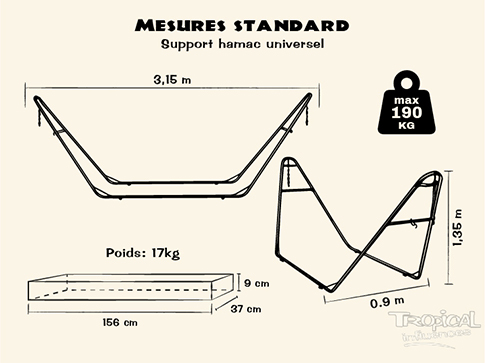
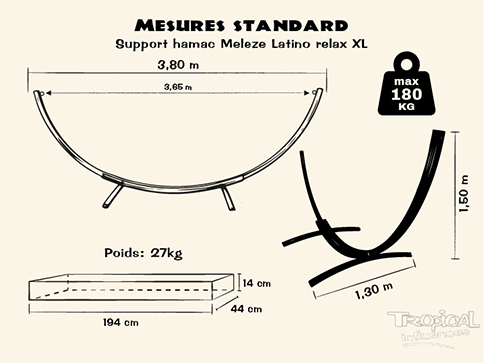
The comfort of a hammock depends on its curve, and this curve directly depends on the length-to-height ratio of the support. A common mistake is to choose based solely on “length.” A support that is too low makes any hammock uncomfortable.. This is especially true with barless hammocks.
Case No. 1: hammock without bars
A hammock without bars (traditional hammock) works like a large flexible fabric that must form an arc. This curve is not a flaw: it is what allows the fabric to stretch out properly when you lie down diagonally. If the support is too low, your buttocks will touch the ground! Not ideal!
Case No. 2: Bar Hammock
Bar hammocks are a bit of a special case. To keep them properly open, they need to be stretched more. As a result, a lower stand can suffice... but that same stand quickly becomes unsuitable as soon as you switch to a true Latin-style hammock, without bars. And that's often where the problem arises. Many bar hammocks, often made in China, are smaller. They are bought in a set with a short, low stand, perfectly calibrated... but only for this type of hammock. When it needs to be replaced, things get complicated. Finding exactly the same model becomes a real headache. And our customers regularly call us disappointed: the hammock wore out quickly, the quality was not up to par, but the stand is still there.
Result: they end up with a sturdy wooden frame... but one that is difficult to use otherwise. So yes, you can try to find a similar model on marketplaces, but you have to want to, especially when you know the quality of these hammocks. This is actually one of the most common problems encountered: customers with an existing frame but no simple solution to fit a comfortable and durable hammock onto it.
A good hammock deserves a stand designed for it, so always choose the same manufacturer for your stand and your hammock.
To go further:Learn more about the ideal height for a hammock stand..
Wooden Hammock Stand: Advantages, Disadvantages, and Lifespan
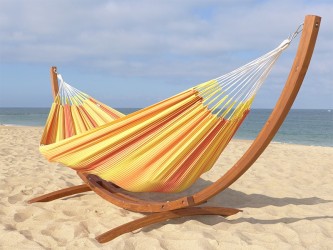
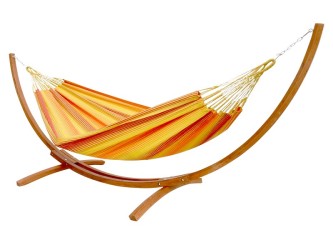
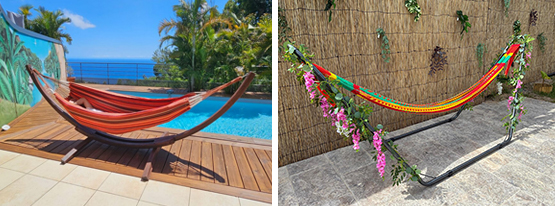
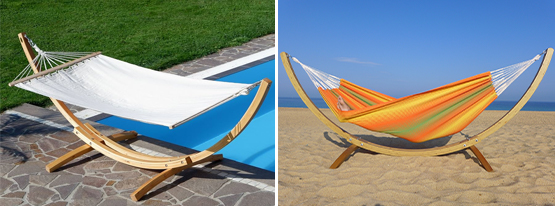
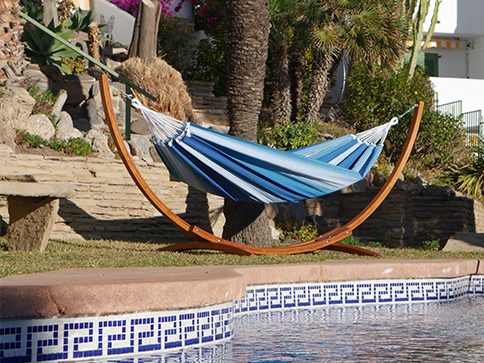
The wooden hammock stand remains the favorite choice of many enthusiasts. It brings a real warmth and naturally fits into an outdoor environment. On a terrace, in a garden, or by a pool, it is a decorative element that is both elegant and very visually pleasing.
The advantages of wood
- warm and natural aesthetic ;
- very beautiful integration into the outdoor spaces ;
- excellent durability potential ;
- repairability and restoration possible on many models ;
- Very good comfort when properly sized.
The disadvantages of wood
- maintenance recommended every few years ;
- greater weight, therefore reduced mobility ;
- natural sensitivity of wood if no maintenance is done ;
- Possible poor winter storage if the wood is kept in a place that is too dry.
Which wood should be chosen for a durable outdoor support ?
For a support intended to remain outdoors, it is better to choose wood species suited for exterior use and a construction in multi-layer glued laminated timber, more stable and more resistant to stress than simple solid wood. Larch, northern spruce treated for outdoor use, or eucalyptus are very good options depending on the models.
Metal Hammock Stand: Advantages, Disadvantages, and Maintenance
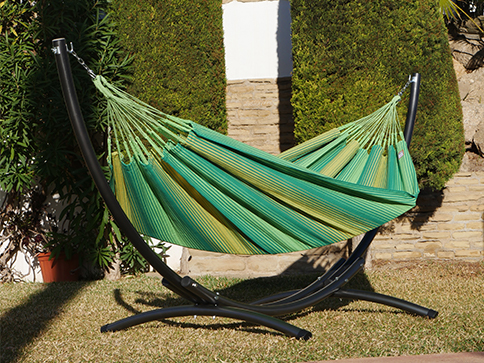
The metal hammock stand is often chosen for its practicality. Lighter, more mobile, and often easier to dismantle, it is ideal for those who want to easily move their hammock according to the sun, shade, terrace, or pool.
The advantages of metal
- facilitated mobility ;
- quick disassembly ;
- practical solution for small spaces or temporary uses ;
- initially low maintenance ;
- a more sober and discreet style.
The disadvantages of metal
- risk of oxidation over time ;
- more sensitive in humid or saline environments ;
- an aspect sometimes considered visually colder ;
- durability related to the quality of finishing and anti-rust treatment.
A metal stand is sturdy and practical, but the paint can wear off at the joints, screws, or welds. With moisture, small rust spots may appear. This is normal, but it should be treated quickly.
Complete comparison: wooden hammock stand vs metal hammock stand
| Criterion | Wood | Metal |
|---|---|---|
| Aesthetics | Warm, natural, decorative | Modern, sober, discreet |
| Maintenance | Recommended periodic maintenance | Rust touch-ups if needed |
| Mobility | Less mobile | Very mobile |
| Outdoor lifespan | Very high if well maintained | Good but variable depending on the interview |
| Comfort | Depends mainly on the height and the geometry | |
| Seaside | Good choice if regularly monitored | More sensitive to salt |
| Ideal use | Sustainable installation | Mobile or seasonal use |
| Your situation | Recommended choice |
|---|---|
| Aesthetic garden | Wood |
| Balcony or mobility | Metal |
| Maximum comfort | Suitable height |
| Temporary use | Metal |
| Long-term use | Wood |
Which support should you choose according to your use ?
- Sustainable garden / fixed relaxation corner: wood.
- Patio decor / pool: wood.
- Intensive family use: high-quality glued laminated timber.
- Temporary accommodation / housing: metal.
- Camping / events: metal.
- Seaside: preferably maintained wood, metal only with strict monitoring.
Discover our categories: see all our wooden supports • see all our metal supports
Real case: the most common mistake
We very often encounter this situation:"Hello, I received a hammock as a gift, and I bought a stand from you... but the hammock is too small. Can I return the stand to you?"In most cases, it is better to change the hammock rather than the support. It is almost always easier to adapt a hammock to an existing support than the other way around. This is especially true when it comes to a real Latin American hammock, longer, more comfortable, and better suited to a beautiful curve. Common mistakes to avoid
- choose a support solely based on the material ;
- choose only according to the length without checking the height ;
- forget the difference between hammocks with bars and hammocks without bars ;
- poorly maintaining a wooden support ;
- ignore the first rust spots on a metal surface ;
- Store a wooden support in a dry, enclosed garage. ;
- to think that a "versatile" stand will necessarily suit all hammocks.
Maintenance: wood vs metal
Maintenance of a wooden stand
The simplest and most consistent option for many external supports remains the saturator. How to do it concretely (simple method):
1. Wood Preparation
- Carry out a light sanding (grit 120 to 150)
- Objective: open the wood pores and improve adhesion
- Carefully dust off
2. Application of the saturator
- Apply 2/3 coats of saturator every 3/4 years
- Respect a time interval of a few hours between the two coats/layers
Stain can also protect the wood, but it requires more regular maintenance. If upkeep is neglected, it can blister or peel, necessitating more extensive sanding. Without maintenance, the wood naturally turns gray. This appearance may be appealing, but in the long term, the material becomes more susceptible to moisture and its durability may decrease.
3. For the winter
- Elevate the feet to prevent them from sitting in water ;
-
-
- loosen the bolts slightly ;
- Ideally store under a canopy or covered terrace ;
- Absolutely avoid the closed plastic tarp ;
- Avoid the enclosed dry garage, which can promote cracks.
-
Maintenance of a metal stand
At the first signs of oxidation, it is usually sufficient to:
- to clean the area ;
- to apply a suitable anti-rust paint ;
- to regularly check the sensitive areas.
Light but regular maintenance significantly extends the lifespan of the support. Then, approximately every 4 years, it is recommended to fully renovate it to restore its attractive appearance and protect it over time.
Metal support in winter
- disassemble the bracket if possible ;
- store it in a dry place ;
- Check the condition of the joints before putting back into service.
To go further: see our tips to protect your hammock and stand in winter.
Our expert recommendation since 1988
A wooden hammock stand is often the best choice for durable, aesthetic, and comfortable use.. This is the favorite material for those who want a beautiful garden or terrace item and are willing to do periodic maintenance. A metal hammock stand is often the best choice for mobile, practical, and seasonal use.. It is very suitable for those who want to move their hammock easily or prefer a solution that is simple to disassemble.
But if there is only one thing to remember, it is this: the decisive criterion is always the height of the stand. To make the right choice, you can trust us: we have known the trade for a long time. Don’t hesitate to call us; we will always find a solution tailored to your needs. Given the very positive feedback from our clients, there is no reason for that to change.Check the reviews on Tropical Hamac.
FAQ – Frequently Asked Questions
Which hammock stand to choose: wood or metal ?
Wood is often recommended for its durability, aesthetics, and comfort, provided one is willing to perform periodic maintenance.
Metal is often preferred for mobility, ease of assembly, and practicality.
Why is the height of the stand so important ?
It determines the curve of the hammock.
👉 A hammock without bars must curve to provide good diagonal comfort.
👉 A support that is too low tightens the hammock and greatly reduces its comfort.
Does a metal hammock stand necessarily rust ?
Oxidation spots can appear over time, especially:
- at the junctions
- to the screws
- to the welds
👉 This can be easily treated if addressed early with a suitable paint.
What maintenance is needed for a wooden hammock stand ?
The saturator is often the simplest solution:
- 2 layers at the start
- then one maintenance coat every few years
👉 Stain also provides protection, but requires more regular maintenance.
What should you do with your hammock stand in winter ?
👉 For a wooden support:
- elevate
- slightly loosen the bolts
- Ideally store it under shelter.
👉 For a metal support:
- dismantle it if possible
- store it in a dry place
Barred or barless hammock: does it matter ?
Yes, it’s essential.
👉 Bar hammocks are stretched tight
👉 Hammocks without bars bend
This is one of the most common mistakes when choosing a medium.
Which hammock stand should I choose by the seaside ?
By the seaside, the salty air gradually corrodes the metal.
👉 A properly maintained wooden support is often more durable.
👉 Metal remains possible, but will require more maintenance.
Which hammock stands do you recommend ?
👉 Discover our wooden supports
👉 See our metal supports
Some flagship models
- Latino Relax XL Hammock Stand
- Latino Relax Hammock Stand L
- Inka Relax Hammock Stand L
- Azteka Relax XL Metal Hammock Stand
Need quick advice? Give us your measurements (hook-to-hook length + hanging height) and the type of hammock. This helps avoid most mistakes.
In summary: Wood or metal is not the real question. The real question is: is your stand well suited to your hammock? A wooden hammock stand is perfect for those looking for a natural, durable, and aesthetic atmosphere. A metal stand is better suited for those who prioritize simplicity, mobility, and more flexible use. However, a well-proportioned good stand will always make more of a difference than just the choice of material.